
The COVID-19 pandemic promoted changes in social and economic dynamics that were already in sight, and that will mark the new agenda of global cities.
As the world moves out of confinement, more and more cities are developing public policy solutions that meet the new demands of people, placing quality of life at the centre of government priorities.
In this sense, the cities climate change agenda becomes particularly relevant.
By redesigning public space for the promotion of sustainable mobility, cities are able to offer a safe, healthy and inclusive transport option in the current context, while at the same time:
- They discourage the use of private cars and reduce greenhouse gas emissions.
- They strengthen the development of local ecosystems.
Before the pandemic
The trend in the world already pointed to cities on a human scale, which combine travel efficiency with environmental commitment.
Learn about the cases of: Paris, “a 15-minute city”, Melbourne “20-minute neighbourhoods” and Nordhavn, “a 5-minute neighbourhood”.
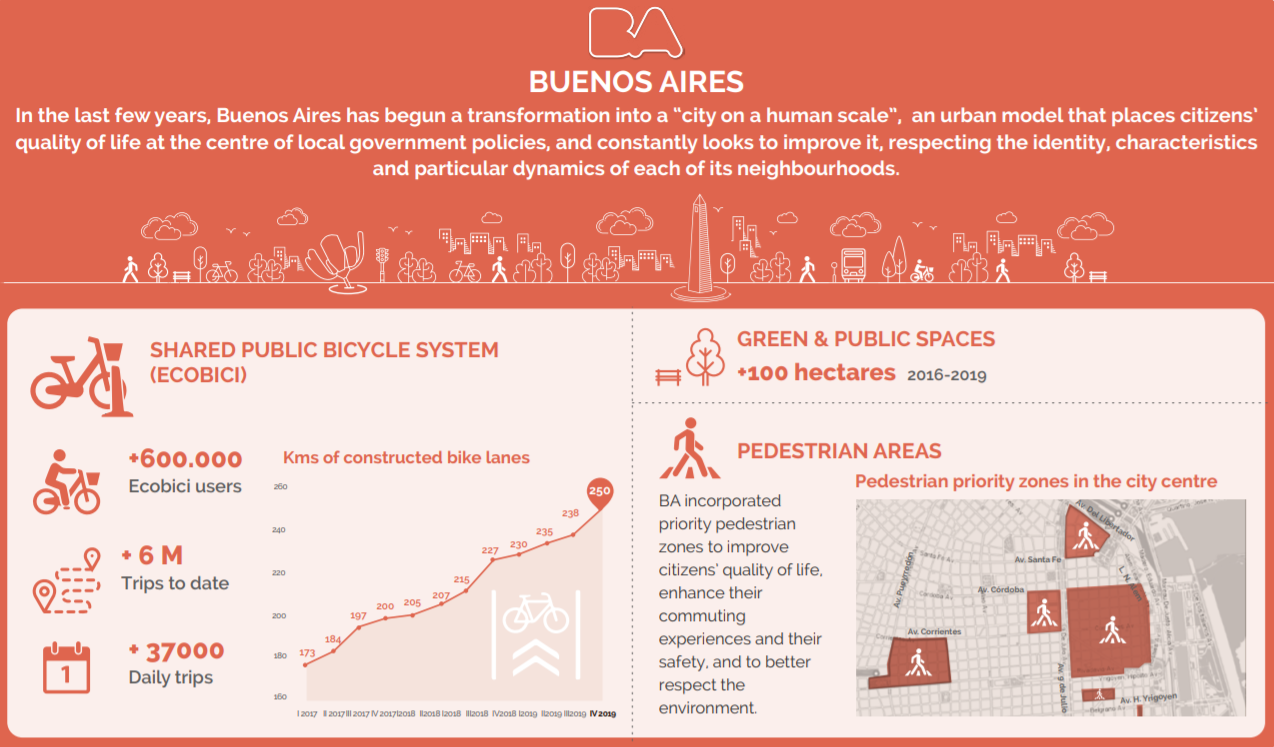
Similarly, in recent years Buenos Aires has also been transformed with the clear objective of becoming a "city on a human scale".
With de pandemic
The examples of global cities that reinforce their spatial and sustainable mobility policies, and innovate in the development of new ones, preserving the safety of their citizens in the way out of the health crisis, have multiplied.
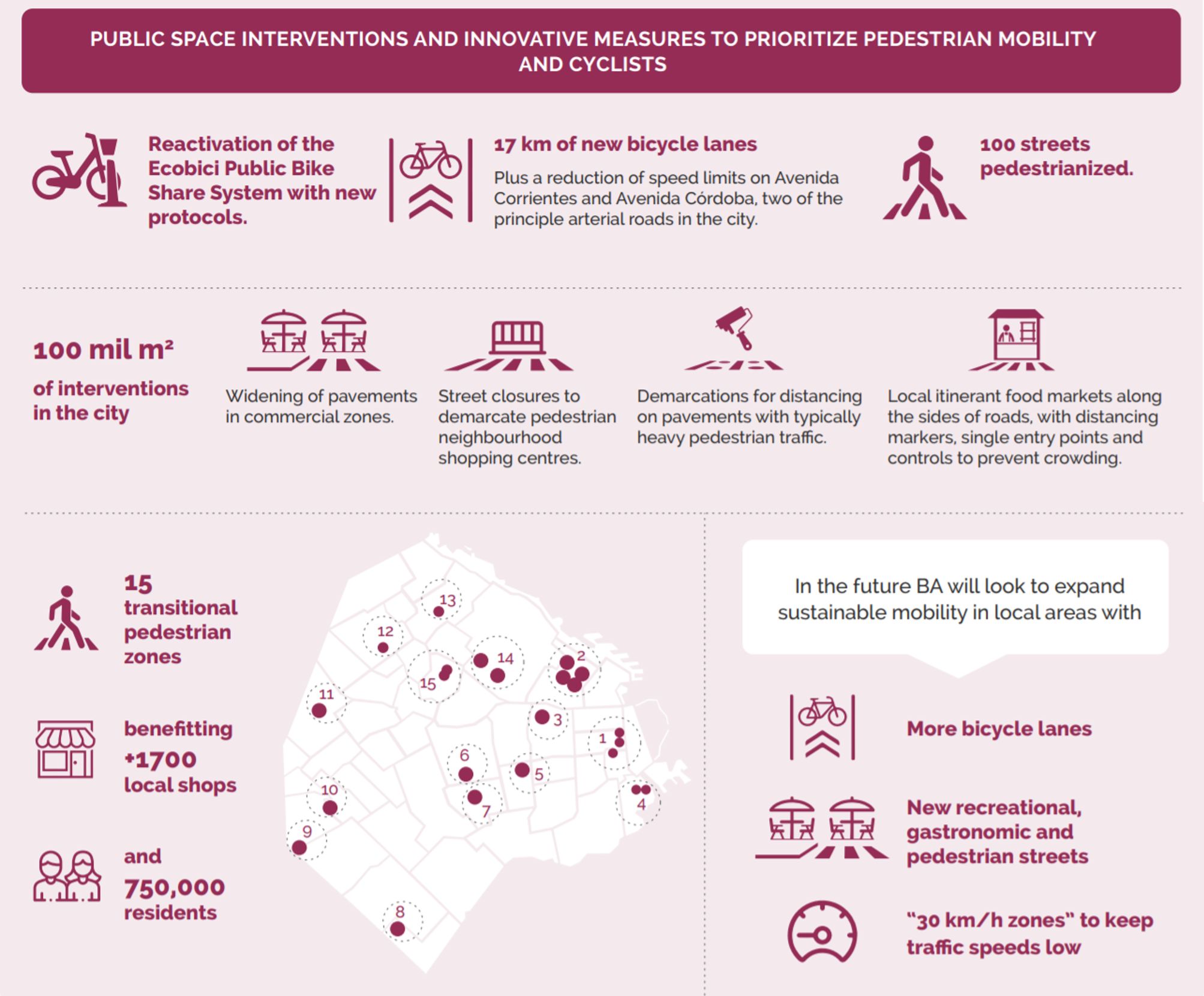
In response to the pandemic, the city of Buenos Aires quickly adapted its urban design to encourage neighbourhood commerce, ensure social distancing, avoid crowding in public space and promote pedestrian and bicycle mobility by eliminating non-essential journeys by public transport and private vehicles.
Learn more about these measures!

Mobility
Discover how much the use of public and private transport has been reduced in the City of Buenos Aires.

Expansion of the bike lane network
Learn about the new bike paths in Corrientes and Córdoba.

Record of cyclists in the City of Buenos Aires
There was an increase of up to 114% in the number of trips compared to 2019. Learn about the details!

Pedestrianisation of 100 streets
Get to know the interventions conducted to promote pedestrian mobility and facilitate social distancing.
Similar measurers around the world
Bogotá
It reinforced its 550 kilometres of permanent bike lanes with additional 80 kilometres of temporary bike lanes.
New York
Open Streets: 100 miles of streets opened for pedestrians and cyclists, with vehicle traffic limited to a few exceptions. The city is also temporarily expanding outdoor seating options for food establishments by allowing the use of pavements and closing streets to traffic.
Milan
The "Strade Aperte" (Open Streets) plan includes new pedestrian areas, more kilometres of bicycle lanes, new areas with a maximum speed limit of 30 km/h, and a redesign of public spaces with open and safe squares.
London
The "London Streetspace" programme aims at an unprecedented transformation of the city, with the construction of temporary cycle lanes; the extension of pedestrian routes in main streets to promote commercial activity; and the creation of low-traffic neighbourhoods.
San Francisco
The "Slow Streets" programme was designed to limit vehicle traffic on certain residential streets and encourage their use as a shared space between different forms of micromobility (people who travel on foot, bicycle, wheelchair, scooter, skateboard, etc.).